I · Besançon
LipFrom the experiment of self-management to the adventure of design
Lip started in 1867 as Emmanuel Lipmann's workshop in Besançon, then the capital of French watchmaking and, perhaps not by coincidence, the home town of Proudhon. By 1931 it was the largest watch manufacturer in France. After the war Fred Lip, who had joined the Resistance while his parents perished in Auschwitz, bet the company on research. The R27 came out on 7 December 1958. Hamilton had got there the year before, hence the rather anticlimactic slogan "the first electric watch... made in Europe".1,2
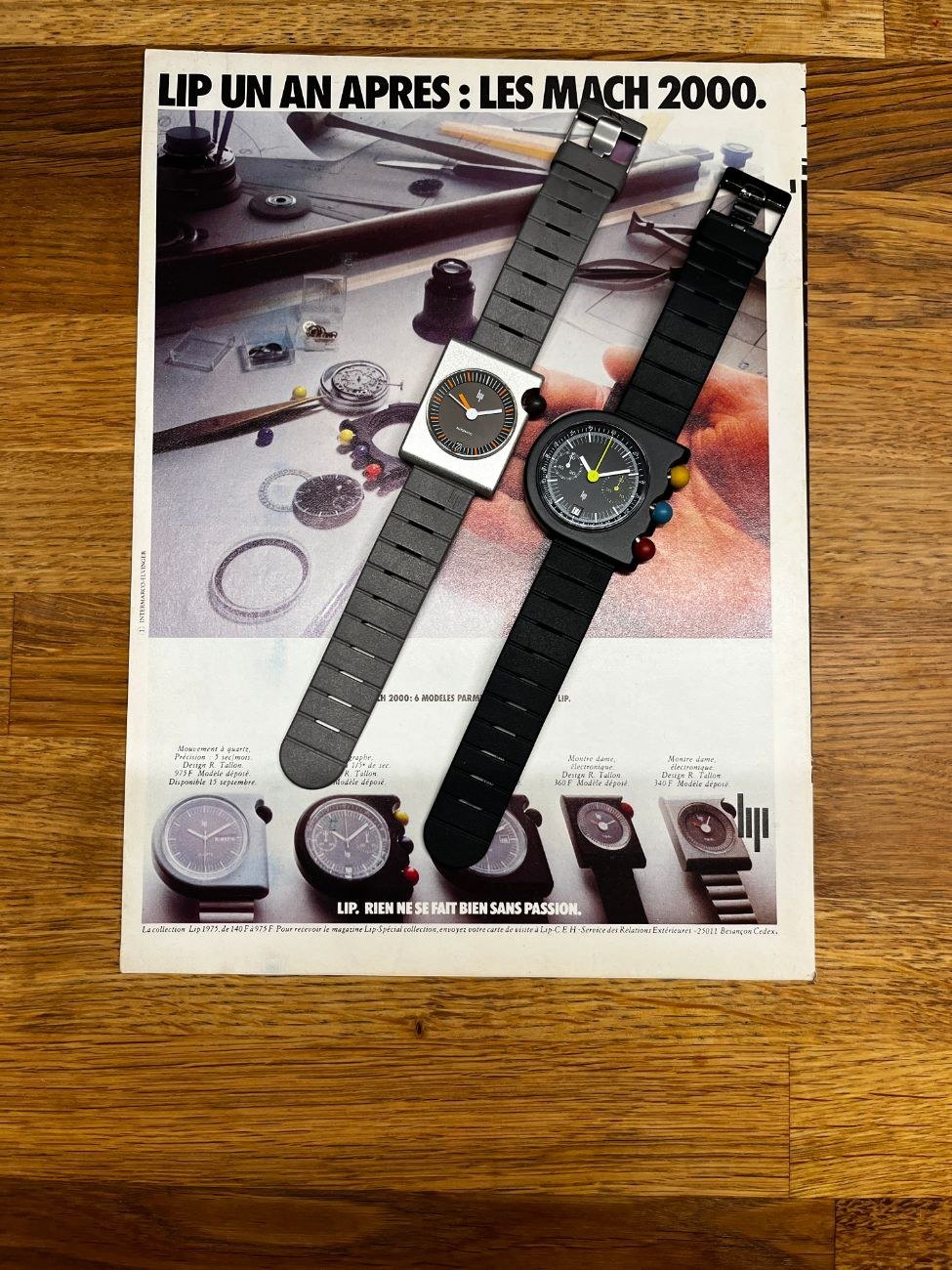
In 1973, when Ebauches SA planned to break up the company, the workers occupied the Palente factory, hid some 65,000 watches around town (a few of them with local monks) and started making and selling watches themselves. C'est possible: on fabrique, on vend, on se paie. After 329 days, the workers won. What followed, under Claude Neuschwander, was Lip at its most creative, with designs by Roger Tallon, Rudi Meyer, Marc Held and Isabelle Hebey.1
- 1867Emmanuel Lipmann founds a workshop in Besançon.
- 1933The shaped T18 calibre, later inside the Churchill and the Futuramic.
- 1958Calibre R27, the first electric watch made in Europe.
- 1962Move to the purpose-built Palente factory. Lip becomes the world's seventh largest manufacturer.
- 1968Nautic-Ski with the R184 is the official watch of the Grenoble Winter Olympics.
- 10 June 1973Workers occupy the factory and begin making and selling watches themselves.
- 1974The workers' plan is accepted. Neuschwander era: Tallon, Meyer, Held, Hebey. First French quartz watch.
- 1976 to 1980Second liquidation, second occupation, then six cooperatives. LIP Industrie survives in Palente.
II · Clinical instruments
Doctors' watchesTelling time in a heartbeat
A pulsometer saves the busy clinician some mental arithmetic. You start the chronograph on a beat, count a set number of pulsations (usually 30 or 15, it says so on the dial) and stop it. The seconds hand then points to the heart rate in beats per minute.11 The asthmometer does the same for respirations. Before chronographs became affordable, duo-dial watches gave nurses and doctors a big separate seconds dial to count against.
Try the scale
Take a pulse
This dial is graduated for 30 pulsations. Take the pulse of a (virtual) patient by watching the lamp, or take your own. Start on the first beat, stop on the thirtieth, and see where the hand lands. No sats probe required.
Patient waiting. Press Start on a beat.
III · Le Locle
ZenithThe first automatic chronograph
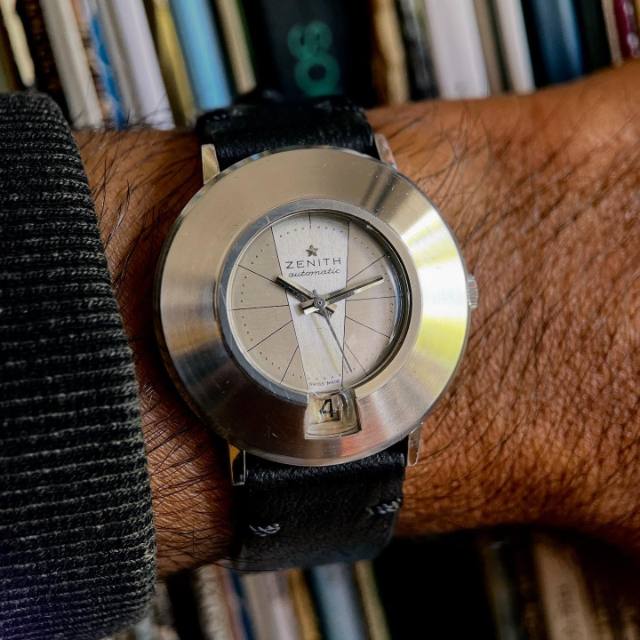
The first automatic chronograph in the world was an arms race, and three watchmakers got to the finish line at the same time, in 1969. Zenith did it with extreme panache: their version, the 3019PHC, was a chronometer-grade, high-beat, integrated chronograph movement. Ten years earlier Zenith had taken over Martel, the chronograph specialists of Les Ponts-de-Martel who had been making column-wheel movements for Universal and for Zenith. This marriage, alongside Zenith's long-established expertise in chronometry, eventually gave us the El Primero.
This collection brings together the El Primero, with its chronograph and automatic Martel siblings, alongside its rivals: the Calibre 11 of the Heuer, Breitling, Hamilton-Büren and Dubois-Dépraz consortium, and the Seiko 6139.4,5,6 Meanwhile, the quartz revolution, and an aggressive takeover of Zenith by the Zenith Radio Corporation, were looming...
Zenith El Primero 3019PHC
Integrated, column wheel, and beating at 36,000 vph, so it can time to a tenth of a second. Shown to the press by Zenith-Movado.4
In the collection: A3818, A788, Movado DatronChronomatic Calibre 11
A Büren micro-rotor base with a Dubois-Dépraz chronograph module on top, and the crown on the left. In the shops by the summer.5,6
In the collection: Hamilton 11001-3, 11002-3Seiko 6139
Vertical clutch, column wheel, sold first in Japan. Usually dated to May 1969, with serial numbers suggesting earlier production.5
In the collection: 6139-6020 pulsationsIV · Curiosities
MiscellanyColour, light and battery-eaters
Watches that don't fit anywhere else. One tells the time in colour, and only approximately. Two keep their red LEDs dark until you ask, otherwise the battery would be gone within hours.
Live, in your time zone
The watch that has time
A dark disc with a single opening turns once every twelve hours over twelve colours. The colour in the window gives you the hour, and how far the window has moved into the next colour gives you, roughly, the minutes. My palette is an approximation of Tian Harlan's.8,9
Display on command
Time on demand
The Pulsar only shows the time when you press the button, for a second or so. Hamilton showed a prototype in 1970, the gold P1 came out in 1972 and the steel P2 in 1973.10 Press the button below. Then press it again, because you will have forgotten what it said.
Calibres
Every movement in the catalogue, linked to its Ranfft entry or, where Ranfft has none, to another source.
Show index
| Calibre | Type | Watches |
|---|
Write to me
A question about one of these, a watch you think belongs here, or a fellow sufferer looking for company. Your message comes straight to me; your address is used only to reply.